The Best House Plan Websites of 2026, Ranked Honestly
Best house plan websites 2026: The drafter's read, from nine years drawing permit-ready plans for owner-builders.
Quick answer: For most US buyers, Houseplans.com is the best starting point thanks to the largest catalog and cleanest search, The Plan Collection is the budget pick for an identical plan at a lower price, and Truoba is the best choice for buyers who want consistent modern designs with CAD and Revit files included in the base price. Because several of these sites share one back-end catalog, search the same plan number across at least three before you buy.
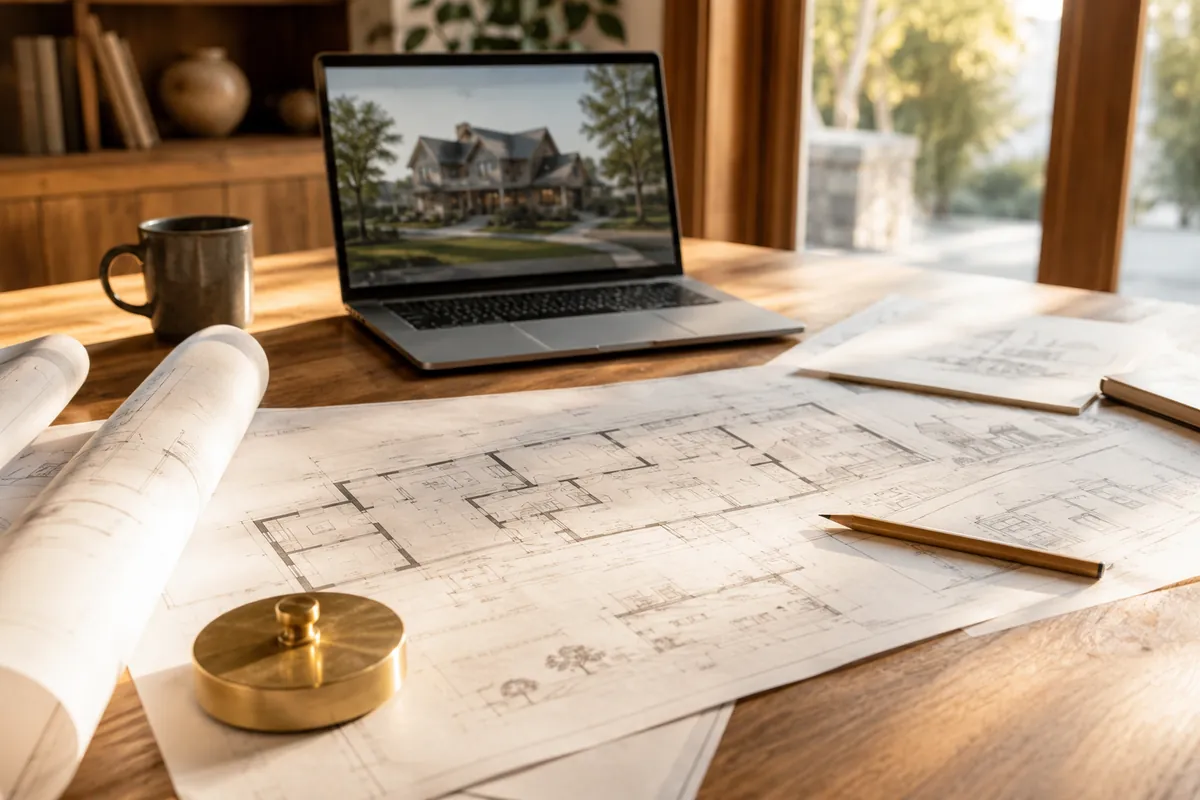
Most people who buy a house plan online buy from the first website that ranks for their search. That site is almost always one of seven publishers, all of which look roughly identical from the outside, and three of which are functionally the same company in different paint. The price you pay for the same plan can vary by 40 percent depending on which front door you walk through. The drawing set you receive can vary even more.
I have spent nine years drafting residential plans for owner-builders across the Pacific Northwest, and a good chunk of my consulting work begins after the buyer has already paid. They open the PDF, see what they actually got, and ask whether this is enough to permit and build with. Sometimes it is. Sometimes the foundation plan is missing entirely. Sometimes the framing schedule has been outsourced to "your local engineer" without warning.
This article ranks the seven publishers most US buyers will actually choose between, on the metrics that determine whether the plan is worth the money: catalog depth, price, what is included in the standard drawing set, modification cost, refund policy, and customer service reputation. I am not paid by any of them. When I link to a plan publisher, I tell you whether the link is affiliate or not.
The seven publishers, at a glance
| Publisher | Catalog | Plan price | Standard set | Modifications |
|---|---|---|---|---|
| Houseplans.com | ~40,000 | $700-$2,000 | PDF + CAD | $300-$2,500 |
| HomePlans.com | ~28,000 | $1,200-$2,200 | PDF only at base | $400-$3,500 |
| Architectural Designs | ~30,000 | $900-$2,200 | PDF + CAD optional | $350-$2,500 |
| The Plan Collection | ~28,000 | $650-$1,800 | PDF + CAD optional | $300-$2,000 |
| Family Home Plans | ~20,000 | $700-$1,800 | PDF only at base | $400-$2,200 |
| Eplans | ~15,000 | $800-$2,000 | PDF + CAD optional | $400-$2,500 |
| Truoba | ~120 | $1,200-$2,400 | PDF + CAD + RVT | $500-$3,000 |
One thing the table does not show: Houseplans.com, HomePlans.com, Eplans, and a couple of others share corporate parentage and a common back-end catalog. The same plan often shows up across multiple sites at different prices. If you have not already paid, it is worth searching the same plan number on at least three of these sites before clicking buy. The savings are real and the plans are identical.
1. Houseplans.com
The largest catalog. The most consistent search experience. The clearest filtering. If you have no preference between publishers and just want to find a plan, this is where most buyers should start.
Houseplans.com lists roughly 40,000 plans across every major US style. Filters work the way you would expect (square footage, bedrooms, garage bays, foundation type, lot dimensions). Plan pages are detailed, with floor plans, exterior renderings, and most of the time real photos from a built home. The platform also publishes a Cost-to-Build estimator on most plans, which gives a rough construction budget based on US average labor and material costs. Treat the estimator as directional. It is consistently 15 to 20 percent low on actual builds in high-cost-of-living markets. If you want a sanity check that is not tied to a sales page, the National Association of Home Builders cost-of-construction research is a better anchor for a per-square-foot baseline.
Standard packages include PDF blueprints, and CAD files (DWG) are typically a $200 to $500 add-on if you want them. CAD matters if you plan to modify the plan locally or if your engineer prefers it over PDF redlines. Most owner-builders do not need CAD. Most contractor-led builds do.
The platform offers a "Modification Estimate Service" that is genuinely useful: you describe the change you want, they connect you with the original designer, and you get a quote before paying for any drafting work. Modification costs vary wildly by designer, but the path is transparent. Some publishers do not offer this and the modification process is opaque.
Refund policy is the standard for the industry: refunds are not available once digital files are downloaded. Pre-download cancellations within 24 hours sometimes get refunded at the discretion of customer service, but do not count on it. The implication is obvious: do not download the file until you are sure the plan is the one.
VerdictThe default starting point. Largest catalog, cleanest interface, useful supporting features. The single most important thing they get right is letting you compare plans across designers without bouncing between pages.
2. HomePlans.com
Smaller catalog, premium positioning, similar quality to Houseplans.com on the plans they do carry. Prices skew higher and the standard package is a little leaner.
HomePlans.com lists about 28,000 plans. The site emphasizes designer partnerships, and you will see the same featured architects (Visbeen, Donald Gardner, Sater Design Collection) prominently. These are real designers with real built portfolios, and the plans they sell here are the same plans they sell on their own websites, often at the same price. There is no first-look discount for buying through HomePlans.com.
The standard package on HomePlans.com is PDF-only. CAD files are an extra $200 to $400. The "Builder Advantage Program" gives professional builders 5 percent off their first plan order, which is meaningful only if you are building three or more spec homes a year. Most owner-builders will not qualify and will not benefit.
Modification options here flow through the original designer rather than through HomePlans.com directly. This is fine when the designer is responsive. It is not fine when the designer is on vacation, retired, or off the platform. The site does not always tell you which scenario you are in until you have paid.
VerdictA good site for buyers who already know which designer's work they want. A frustrating site for buyers comparing across designers, because the catalog is smaller and the prices are not consistently better than the alternatives.
3. Architectural Designs
Roughly 30,000 plans. Strong on Modern Farmhouse and Craftsman, which are the two most-built styles in the US right now. The site has a built-in cost estimator, a builder rewards program, and an affiliate program for content publishers. The catalog overlaps significantly with Houseplans.com.
What Architectural Designs does well is the plan detail page. They commission custom 3D renderings of nearly every plan and publish full interior virtual tours on a meaningful percentage of them. If you are someone who needs to see what a plan would feel like as a built home before you buy, this is the platform that comes closest to giving you that. Houseplans.com has photos on a higher percentage of plans, but the interior tours on Architectural Designs are unique to that publisher.
Standard package is PDF, with CAD available as an add-on. Modification packages exist but are routed through the designer. Customer service reputation is mixed. They are responsive on plan questions before purchase. They get less responsive on technical issues after the file has been downloaded. The same complaint applies to most publishers in this space.
VerdictA legitimate alternative to Houseplans.com, especially if you respond strongly to interior visualizations. The catalog overlap means you are often choosing on price between the two, and the price is sometimes better here. Sometimes worse. Always check both.
4. The Plan Collection
The budget pick. Same shared catalog backbone as Houseplans.com on a meaningful percentage of plans, often $50 to $200 cheaper for the identical drawing set.
The Plan Collection lists about 28,000 plans. Search and filtering are functional but a step less polished than the leaders. Plan detail pages are sometimes thinner than what you would see for the same plan on Houseplans.com. The plan itself is the same plan. The difference is the website you bought it from.
Standard packages are PDF or PDF + CAD bundles. Modification flow exists. Customer service exists. The reason people choose The Plan Collection is the price. Identical plan, less money. Compare the same plan number across this site and Houseplans.com. The price difference is real.
VerdictIf you have already chosen a plan and just want the cheapest legitimate place to buy the same drawing set, check this site first. The cost savings are not life-changing, but they are real, and the plan is the same plan.
5. Family Home Plans
About 20,000 plans. Smaller catalog, narrower stylistic range. The strength here is the focus on traditional and family-oriented plans (multi-bedroom, multi-bath, garage attached, classic exteriors). The weakness is everything else.
Family Home Plans is the publisher to consider if you have already decided you want a traditional, suburban-style plan. If you are looking at modern, minimalist, barndominium, or cabin styles, the catalog is narrow and the leaders cover those styles better. The standard package is PDF, with CAD as an upgrade. The website itself feels a generation behind the design quality of Houseplans.com.
VerdictUseful for the plans they specialize in. Easy to skip if your style is anything else.
6. Eplans
About 15,000 plans. Eplans is in the same corporate family as Houseplans.com and HomePlans.com, and the catalog overlap reflects it. Most of what you find here you will also find on the larger sites, sometimes at lower prices.
Eplans does well on three things: the search experience is better than Family Home Plans, the cost-to-build estimator is functional, and the modification flow is the same one that Houseplans.com uses. None of those are unique to Eplans. The reason to come here is occasionally a different price on the same plan. There is no other reason.
VerdictA second tab for price comparison, not a primary destination. Search the same plan numbers across Eplans, Houseplans.com, and The Plan Collection before paying. Take the cheapest of the three.
7. Truoba
The outlier. Truoba is a Lithuanian design firm with a deliberately curated catalog of about 120 modern plans, all drawn by the same in-house team. Every plan ships with PDF, DWG (CAD), and RVT (Revit) files included in the base price. Modifications are quoted directly with the designers and are typically faster than the marketplace alternatives.
Truoba is not for everyone. The aesthetic is unmistakably modern, the prices are at the higher end of the range, and the catalog is small. But the consistency is something the marketplace publishers cannot match. Every plan is the same firm's work, drawn at the same standard, with the same level of detail in the framing and electrical schedules. If you are building a modern home and you value consistency over selection, Truoba is the right answer.
VerdictA focused alternative to the marketplaces. Premium pricing for premium consistency. The CAD and Revit files in the base price are a real differentiator if your engineer prefers either format. Browse the Truoba catalog →
How to actually choose
The publisher is rarely the most important decision. The plan is. Most buyers come at this the wrong way: they pick a publisher, browse that publisher's catalog, and end up choosing from a smaller pool than they realized was available. The right approach is the inverse.
- Decide the style first. Modern Farmhouse, Craftsman, Cape Cod, Modern Minimalist, Barndominium. The style narrows 200,000 plans to 5,000.
- Decide the size and layout next. Bedrooms, bathrooms, garage, square footage, single-story or two-story. This narrows 5,000 to 200.
- Now pick three to five candidates that fit. Search each candidate plan number across Houseplans.com, The Plan Collection, Architectural Designs, and Eplans. The same plan often appears at different prices on different sites.
- Choose the publisher with the lowest price for the standard set you actually need. If you need CAD, look at the bundle price. If you do not need CAD, save the money.
- Confirm the modification path before you buy. Some plans are designed by retired or unresponsive designers. The publisher will not always volunteer this. Email the publisher to confirm the original designer is available for modifications, especially if you anticipate even minor changes.
The biggest single mistake I see in my consulting work is buyers choosing a plan based on the rendering and discovering, after download, that the floor plan does not actually fit the way they live. The rendering is a marketing artifact. The floor plan is the contract. Spend more time on the floor plan than on the picture, and the rest of this gets easier.
What about modifications?
Almost every buyer ends up wanting at least one modification. The most common ones I see are:
- Flipping the plan (reverse layout) so the garage is on the opposite side of the lot from the original drawing
- Changing the foundation type to match the local jurisdiction (slab, crawl, basement). Whether a given change needs an engineer's stamp often comes down to how your area has adopted the International Residential Code, so confirm with your building department before you commit
- Adjusting ceiling height in the great room
- Repurposing a flex room as a primary suite extension
- Adjusting kitchen layout to accommodate appliances the designer did not plan for
The first two are usually inexpensive ($200 to $600 total). The last three vary widely by designer and by what else has to move structurally. Get the modification quote in writing before you commit to the plan. A plan that costs $1,400 and needs $2,800 in modifications is a $4,200 plan. Compare it on those terms to a different plan that costs $1,800 and needs $300 in modifications, and the answer flips.
Refund policies, briefly
Every publisher in this list has the same refund policy: no refunds after the file has been downloaded. The reason is the same across the industry, which is that there is no way to recover the file. Once you have it, you have it. Some publishers offer pre-download cancellations within a window of a few hours to a day, but this is at the discretion of customer service rather than a policy you can rely on.
The practical implication is that you should never download the file until you are absolutely certain. Read the floor plan three times. Email the publisher with any technical questions. Confirm the modification path. Then download.
The single biggest thing this article has not said yet
The plan is the cheap part of building a home. A good plan costs $1,200. The home it describes costs $400,000 to $1,200,000 to build (our 2026 cost-to-build breakdown walks through where that money actually goes, line item by line item). The numbers are not even in the same world. This means two things.
The first is that buyers should not optimize too hard on the plan price. Saving $200 by choosing a cheaper publisher is meaningful. Saving $200 by choosing a worse plan that costs $20,000 more to build is not.
The second is that the plan is the lowest-leverage decision in the project. The highest-leverage decisions are the lot, the builder, and the financing. The plan determines what the home will look like and how it will feel to live in. The other three determine whether the project finishes on budget, finishes at all, and is yours to keep when it does. Buy a good plan. Then spend most of your remaining attention on the other three.
Frequently Asked Questions
What is the best website to buy house plans in 2026?
For most buyers, Houseplans.com is the best default: it has the largest catalog, the cleanest filtering, and the most consistent search experience. If you already know the exact plan you want, The Plan Collection often sells the identical drawing set for less. For consistent modern designs with CAD and Revit included, Truoba is the strongest specialist.
Why is the same house plan a different price on different sites?
Several of the major publishers, including Houseplans.com, HomePlans.com, and Eplans, share corporate parentage and a common back-end catalog, so the same plan appears across multiple storefronts at different prices. The plans are identical drawing sets. Searching one plan number across at least three sites before buying can save 40 percent on the same files.
What is included in a standard house plan package?
A standard package is usually PDF blueprints, which is enough to permit and build in many jurisdictions. CAD (DWG) files are typically a $200 to $500 add-on and matter if you plan to modify the plan locally or your engineer prefers them. Truoba is the exception, bundling PDF, DWG, and Revit (RVT) into the base price.
Can you get a refund on a house plan?
Generally no. Every major publisher uses the same policy: no refunds once the digital files have been downloaded, because the files cannot be recovered. Some offer discretionary pre-download cancellations within a short window, but you should not rely on it. Read the floor plan carefully and confirm the modification path before you download.
Do I need to modify a stock house plan?
Most buyers end up wanting at least one change, commonly flipping the layout, switching foundation type, or adjusting the kitchen. Simple changes like a flip or foundation swap often run $200 to $600, while structural or layout changes vary widely by designer. Get the modification quote in writing before you commit, because a cheap plan with expensive changes can cost more than a pricier plan that fits as drawn.
Are there free house plan websites?
There are free home-design tools, but they are not the same thing as a permit-ready plan. Free floor-plan apps (Floorplanner, SketchUp Free, and the design tools some publishers bundle on plan pages) let you sketch layouts and visualize rooms, which is genuinely useful early on. What they do not give you is a stamped, code-compliant construction set your building department will accept. Expect to design for free, then buy or commission the actual permit set. The publishers ranked above start around $650 to $1,200 for that set, which is still 1 to 3 percent of what the house itself will cost to build.
Coming next on HomePlanHQ
This is the first in a series. Future articles will go deeper on individual styles (Modern Farmhouse, Craftsman, Barndominium), on the specific contents of a permit-ready drawing set, on stock-plan-versus-custom decision frameworks, and on the modification process from quote to delivery. We are also building out style-specific publisher rankings, so a buyer searching for a Modern Farmhouse can land directly on the publisher with the deepest catalog in that style without comparison shopping seven sites.
The first of that series is already live: how to read a house plan before you buy, a drafter's walkthrough of what each sheet in the drawing set is actually telling you and what it quietly leaves out.
If you are building soon and want a second opinion on a plan you are considering, the email is below. We do not charge for first-pass questions on plans we have already reviewed.