Cost to Build a House in 2026: Real Numbers
Quick answer: In 2026, building a stick-built house in the US runs roughly $150 to $300 per square foot for the structure itself, with land prep, permitting, and soft costs adding 15 to 30 percent on top. A 2,500 square foot mid-range home lands around $375,000 on the low end and $750,000 on the high end all-in. Where your lot sits, how flat it is, and what your jurisdiction charges drive most of that spread.
Enter your square footage and region for an instant 2026 all-in range (structure plus land prep, permitting, and soft costs).
All-in includes site prep, permitting, and soft costs. Sloped lots, custom design, and high-efficiency systems push toward the top of the range; flat lots and stock plans toward the bottom.
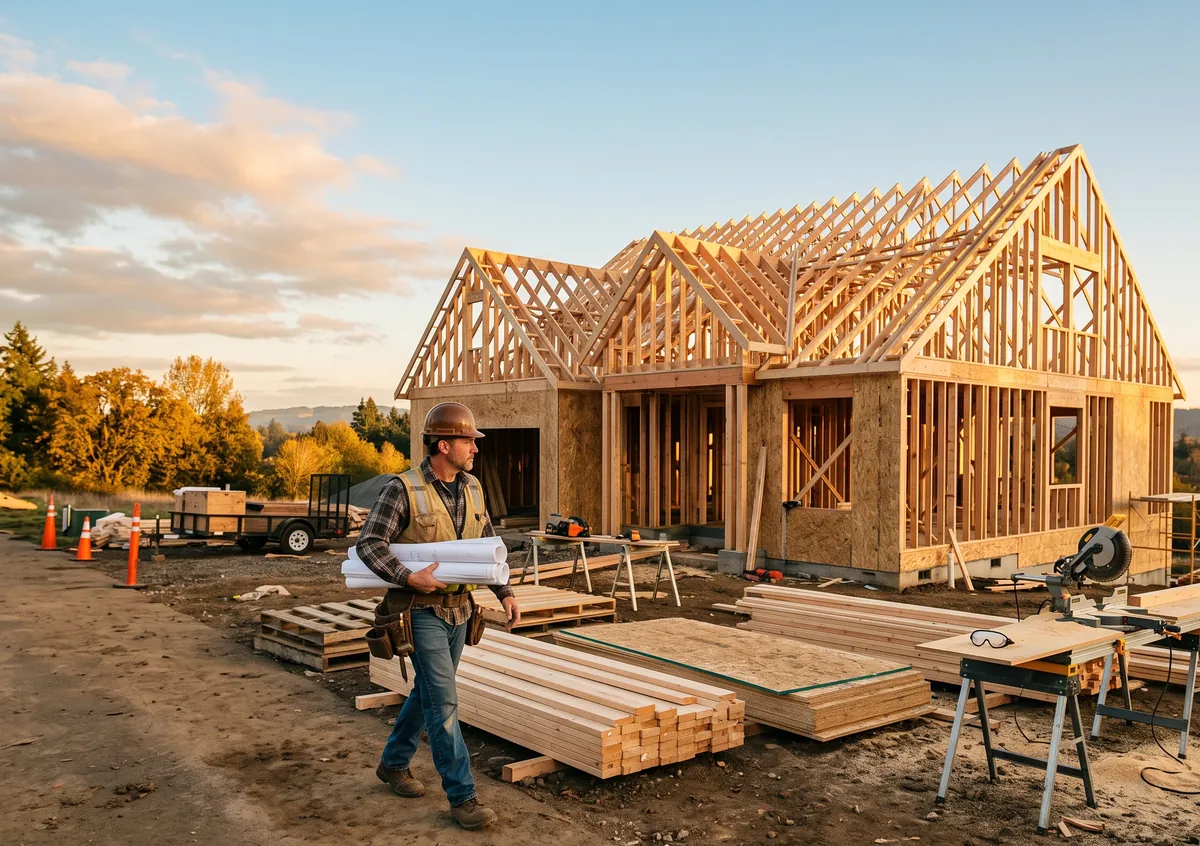
The first owner-builder I ever sat with wanted a 2,400 square foot single-story on a sloped lot east of Bend. He had run the numbers on a spreadsheet his brother-in-law put together. He came in expecting $360,000 all-in. The build closed at $612,000, and that was before he furnished it. Nothing had gone wrong. He just had not priced the stem wall on a hill, the engineered foundation the geotechnical report demanded, the impact fees the county added in the permit window, or the eight months of construction loan interest that compounded while framing waited on a long-lead truss order. His spreadsheet was honest. It was just incomplete.
I have spent nine years drafting permit-ready sets for owner-builders and small contractors across Oregon, Washington, and Idaho. The question I get more than any other is some version of: what is the real cost to build a house in 2026, with site work and soft costs and the line items the spreadsheet packs don't surface. For anyone planning a house in 2026 real construction costs cluster across a wider band than most online calculators admit. The honest answer in 2026 is that for a stick-built home in the United States you should plan on $150 to $300 per square foot, and the spread between those two numbers is almost entirely about where your lot sits, how flat it is, and what your jurisdiction asks for at the counter. NAHB's single-family cost-of-construction survey put the national average for new construction near $162 per square foot of finished space for the build itself, and HomeAdvisor's aggregated owner-reported data clusters the all-in number, including land prep and soft costs, between roughly $150,000 and $600,000 depending on size. Those ranges have held up into 2026 with material costs roughly flat and labor up modestly.
Before the prose, here is where the money actually goes on a typical US single-family build, by line item, using the most recent national benchmark.
| Construction stage | Share of build cost | Approx. cost on the average US home |
|---|---|---|
| Interior finishes (drywall, cabinets, flooring, paint, trim, fixtures) | 24.1% | ~$103,200 |
| Major system rough-ins (HVAC, plumbing, electrical) | 19.2% | ~$82,200 |
| Framing (floors, walls, roof, sheathing) | 16.6% | ~$71,100 |
| Exterior finishes (siding, roofing, windows, exterior doors) | 13.4% | ~$57,500 |
| Foundations (excavation, footings, slab or stem wall) | 10.5% | ~$44,700 |
| Site work (permits, grading, utility connections at the site) | 7.6% | ~$32,700 |
| Final steps (driveway, deck, landscaping, final cleanup) | 6.5% | ~$27,800 |
| Other | 2.1% | ~$9,000 |
| Total construction, structure only | 100% | $428,215 |
Source note: figures are from the NAHB Cost of Constructing a Home survey (2024 data, published 2025), the home-building industry's standard line-item benchmark. The average build in that survey ran $428,215 across 2,647 finished square feet, about $162 per square foot for the structure itself, excluding land and the general contractor's fee. The national per-square-foot anchor is consistent with the Census Bureau's Survey of Construction. Read this as the structure cost only. The 15 to 30 percent in land prep, hookups, fees, and loan interest discussed below stacks on top.
What The Per-Square-Foot Number Actually Means By State
National averages are a starting point, not a forecast. Texas and Ohio routinely land around $130 per square foot for the build itself on a flat suburban lot with municipal utilities. California, Massachusetts, and the New York metro start at $300 per square foot and climb from there, especially on infill lots where a small home in a tight neighborhood carries the same fixed permitting and design overhead as a much larger build elsewhere. The Pacific Northwest where I work sits in the middle, around $200 to $260 per square foot for a typical 2,000 to 2,800 square foot home. Florida and the southeastern coast hover near the national average for the structure itself but absorb hurricane code requirements that drive truss tie-down, impact glazing, and engineering review costs into the project that buyers from other states never have to think about.
Use a 2,500 square foot mid-range example to anchor expectations. A reasonable all-in for that house, including land prep, permits, design, soft costs, and a modest contingency, runs $375,000 on the cheap end and $750,000 on the expensive end. That is not the construction cost alone. That is the number you should be running through your construction loan calculator.
The Cost Stack Inside The Build
When I break a typical project down for clients I draw it on a yellow pad like this. Foundation work, including excavation, footings, stem wall or slab, drainage, and waterproofing, runs 8 to 12 percent of the build. Framing, sheathing, and the rough structure including the roof package take 14 to 18 percent. Exterior finish, which is siding, roofing, windows, and exterior doors, lands at 12 to 15 percent. Spec choices here, especially window performance and insulation, also drive long-term operating cost, and the Department of Energy's guidance on energy-efficient home design is a useful reference when you weigh upfront cost against decades of utility bills. Interior finish, which is the bucket most owner-builders underestimate the most, takes 25 to 30 percent. That includes drywall, paint, flooring, cabinets, countertops, trim, interior doors, and built-ins. Mechanical, electrical, and plumbing, which the trades call MEP, eats another 13 to 17 percent. Soft costs, which is permits, design, engineering, surveys, and fees, take 5 to 10 percent.
If you stack those midpoints they sum to roughly 90 percent. The remaining 10 percent is contingency. I tell every client to pencil it on top of their hardest number. If you do not spend it, you have a furniture budget. If you need it, you will be glad it is there.
The Hidden Costs Spreadsheets Miss
This is the section worth slowing down on. Most cost-to-build estimates online assume a flat lot inside a city limit with municipal water, sewer, and power at the property line. If your lot does not match that profile, the math gets uncomfortable.
Site preparation on a sloped lot can add $20,000 to $80,000 over a flat-lot baseline. Cut and fill, retaining walls, re-grading for drainage, and a longer foundation footprint all stack. I have seen a single retaining wall, a non-negotiable one engineered for an uphill driveway, run $45,000 on its own.
Well and septic, if you are rural, run $15,000 to $45,000 combined. A drilled well in basalt country, which is most of central Oregon and a chunk of Idaho, can hit $25,000 by itself depending on depth. A standard septic system on suitable soil is $12,000 to $20,000. If your perc test comes back poor and you need a sand-filter or pressurized mound system, double that.
Utility hookups range $5,000 to $30,000. A power company quote of $18,000 to set a new transformer and run service 600 feet from the road is common. Natural gas extension, if available at all, is similarly priced. I have a client who paid $11,000 for water service from the meter at the road into a house pad 300 feet uphill.
Permit fees vary more than any other line item. A modest single-family permit in rural Idaho can be $1,200. The same square footage in a coastal California municipality with school impact fees, transportation impact fees, and a design-review process can run $15,000 or more before you add the building permit itself. Call your jurisdiction. Get the actual number. Then add 15 percent because the fee schedule will probably have updated by the time you pull the permit.
Construction loan interest is the cost owner-builders forget the hardest. A construction loan typically charges interest only on the drawn balance, but at roughly 1 percent per month of the average drawn amount. On a $500,000 build that takes 10 months, your interest carry runs $20,000 to $30,000. If your build slips to 14 months because the framers are booked or the trusses are late, that line item grows accordingly.
Surveys, soils tests, and engineering reviews add another $3,000 to $12,000. A boundary survey is $1,500 to $3,500. A geotechnical report on anything other than a flat sandy lot is $2,500 to $6,000. Structural engineering for the truss package, the shear walls, and any non-standard spans is another $2,000 to $5,000. None of this is optional. All of it gets requested at permit submittal.
Why The Plan You Choose Drives Twenty Percent Of The Outcome
Here is the part that surprises people. The plan itself is a tiny line item. A stock plan from a reputable publisher runs $1,000 to $2,500 for a permit-quality set. A custom plan from an architect or experienced drafter runs $5,000 to $15,000 and up. Modifications to a stock plan, things like flipping a layout, expanding a kitchen, or adjusting a foundation type for your soil, run $500 to $5,000 depending on how deep the changes go.
So the plan is roughly 1 to 3 percent of your total project cost. But the plan is also the document that locks in 80 percent or more of every cost decision that follows. Roof complexity, framing efficiency, the ratio of exterior wall to floor area, whether your spans need engineered lumber, how the MEP routes, the cabinet count, the window schedule. Every one of those drives cost, and every one of them is decided before a shovel hits dirt.
I have watched two clients build the same square footage on adjacent lots with different plans. One picked a clean rectangular two-story with a simple gable roof. The other picked an L-shaped single-story with three roof intersections, two bump-outs, and a covered wraparound porch. Same finishes. Same builder. The L-shaped house came in 22 percent more expensive. The plan made that decision a year before the framers showed up.
This is why I spend so much time with clients on plan selection before we touch modifications. The cheapest place to fix a cost problem is on paper. Once you are framing, every change order is a multiple of what it would have cost to redraw a wall.
Owner-Builder Versus General Contractor
If you act as your own general contractor, the standard rule of thumb is you save 10 to 20 percent of the build cost. The number is real. So is the cost on the other side of the ledger. You will spend 6 to 12 months managing trades, scheduling deliveries, pulling inspections, and handling problems that come up at 7 a.m. on a Tuesday. Your construction loan interest grows during the extra time. Your liability insurance is more complicated and more expensive. If a sub gets hurt and is not properly covered, the exposure lands on you in ways it would not land on a licensed GC.
I have seen this work and I have seen it fail. The owner-builders who succeed have either a trades background themselves, or a flexible schedule, or both. The ones who get into trouble are the ones treating it like a part-time job around a full-time office career. Be honest about which group you are in.
The Barndominium Question
A barndo built on a post-frame or steel shell typically runs $90 to $180 per square foot finished. A comparable stick-built runs $150 to $300. So yes, the barndo is roughly 30 to 40 percent cheaper per square foot for similar finished space. Why: the shell goes up faster, there is less framing labor, and the open clear-span interior reduces load-bearing wall complexity. Trade-offs exist. Resale is regional and uneven. Financing a true post-frame structure can be harder. Insurance can be slightly higher. Some jurisdictions still treat them with extra scrutiny at permit. They are a real option, particularly on rural acreage in the Mountain West and Plains states. They are not a free lunch.
Frequently Asked Questions
How much does it cost to build a house in 2026?
Plan on roughly $150 to $300 per square foot for a stick-built home in the US, covering the structure itself. Add 15 to 30 percent for land prep, permitting, design, and other soft costs. A 2,500 square foot mid-range home runs about $375,000 to $750,000 all-in, with the spread driven mostly by location, lot slope, and local fees.
Is it cheaper to build or buy a house in 2026?
It depends heavily on your market and lot. Building gives you control over the plan and finishes, but site work, utility hookups, and construction loan interest can push the all-in cost well past comparable existing homes, especially on rural or sloped lots. In high-cost metros where land is scarce, buying is often cheaper. In areas where you already own buildable land with utilities at the road, building can compete.
What hidden costs do cost-to-build estimates miss?
Online estimators usually assume a flat lot inside city limits with utilities at the property line. The line items they skip are site prep on a slope ($20,000 to $80,000), well and septic if rural ($15,000 to $45,000), utility hookups ($5,000 to $30,000), permit and impact fees, construction loan interest, and surveys, soils tests, and engineering reviews ($3,000 to $12,000). On an atypical lot these can add tens of thousands of dollars.
How much does the house plan affect the total build cost?
The plan is only about 1 to 3 percent of total project cost, but it locks in 80 percent or more of every cost decision that follows: roof complexity, framing efficiency, span sizes, MEP routing, and the window and cabinet schedules. Two homes of identical square footage can differ by more than 20 percent in build cost based on plan shape alone. The cheapest place to fix a cost problem is on paper, before framing starts.
Is a barndominium cheaper to build than a traditional house?
Usually, yes. A barndominium on a post-frame or steel shell typically runs $90 to $180 per square foot finished, versus $150 to $300 for comparable stick-built space, roughly 30 to 40 percent less per square foot. The shell goes up faster and the open clear-span interior cuts framing labor. The trade-offs are uneven resale, harder financing on true post-frame structures, slightly higher insurance, and extra permit scrutiny in some jurisdictions.
Where To Go From Here
If you have made it this far and the numbers still pencil for your situation, the next step is plan selection. That is the document that locks in most of the decisions you just read about. Start with our honest comparison of the best house plan websites of 2026, which ranks the major US publishers on price, drawing sets, and modification cost, and flags where several of them sell the identical plan for up to 40 percent less. Browse by what fits your lot and your budget per square foot, and put your stake in the ground there. The build math gets a lot easier once the plan is the variable that stops moving.