Stock House Plan or Custom Design: How to Decide
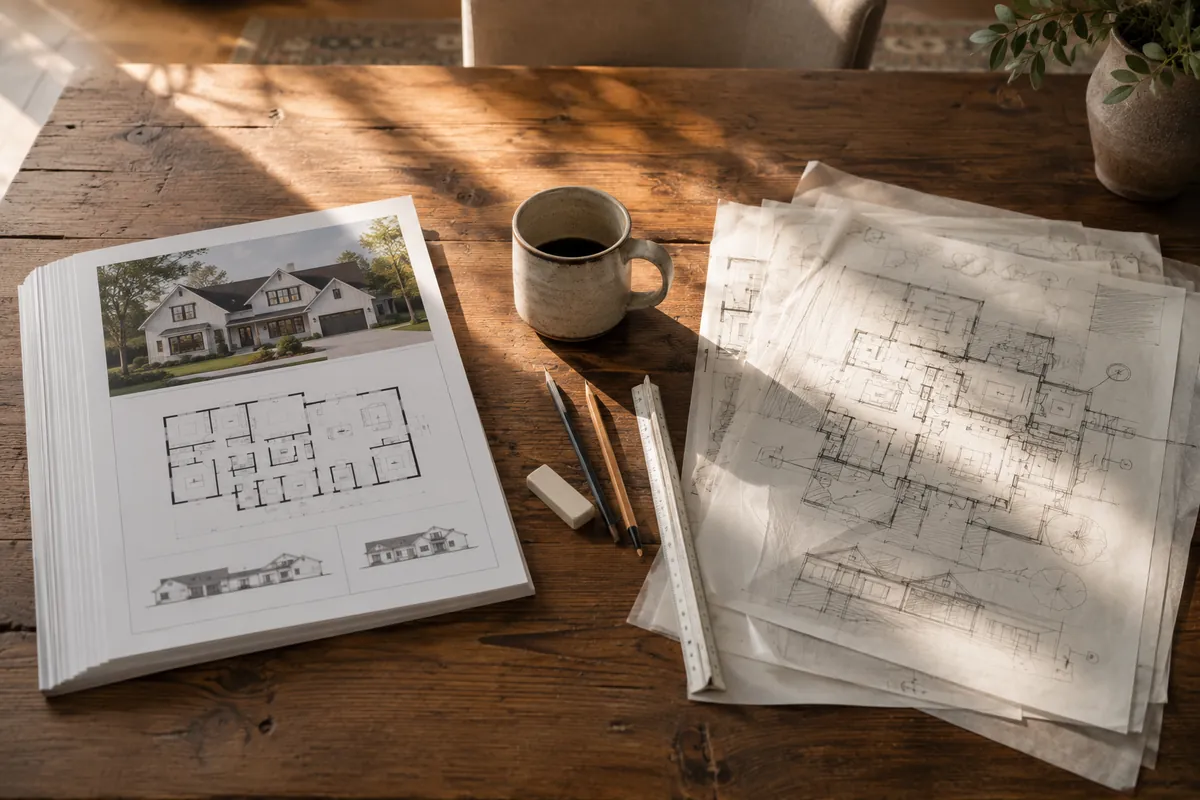
Stock house plan vs custom: The drafter's read, from nine years drawing permit-ready plans for owner-builders.
There is a moment in nearly every owner-builder project where the buyer wonders whether they made the right choice between a stock plan and a custom design. Usually it happens about three weeks after closing on the lot, when the rough idea of the build has hardened into specific demands and the floor plan they liked online no longer fits the family they actually have. Most of the time the right call had been made and the second-guessing is just nerves. Sometimes the second-guessing is the buyer's instinct catching up to the obvious answer they avoided two months ago. The trick is to make the decision before the second-guessing starts.
This article is the framework I walk clients through before they commit to either path. It is seven questions. The questions cluster into three groups, and the cluster you fall into usually decides the answer.
The framework, in two sentences
If your needs fit a common pattern (rectangular lot, mainstream layout preferences, mainstream style), a stock plan is almost always the right call. If your lot or your needs are unusual, the cost of fighting a stock plan into shape exceeds the savings, and a custom design is faster, cheaper in total, and produces a better home.
The seven questions below isolate the variables that determine which side of that line you are on.
Question 1: Is the lot rectangular and roughly flat?
Stock plans assume a rectangular, roughly flat lot with the front edge facing a public road, plenty of buildable area, and no easements eating the buildable footprint. About 70 percent of US single-family lots fit this assumption. The other 30 percent do not, and stock plans struggle on them. The National Association of Home Builders tracks how lot characteristics shape what gets built, and irregular or sloped sites consistently push projects toward custom or heavily modified designs.
Lot conditions that push toward custom:
- Slope of more than 15 percent across the building footprint.
- Narrow frontage (under 50 feet) on a deep lot, which forces the home to be long and narrow.
- Wedge or pie-shaped lot.
- Significant easements that constrain the buildable area.
- View corridors that should drive the orientation of glazing.
- Wetlands, floodplain, or critical-area setbacks that pull the buildable footprint into an irregular shape.
If your lot fits any of these descriptions, stock plans will require significant modifications to fit, and the modifications will compound. By the time you have flipped the plan, narrowed the footprint, repositioned glazing for the view, and added a step-down for the slope, you have spent $4,000 in modifications on a $1,400 plan and the original designer's vision is no longer present in the result. A custom design starts from the lot and produces a building that fits.
Question 2: Are your layout preferences mainstream?
Stock plans are mainstream by definition. The plans that get drawn, marketed, and bought are the plans that match what most US buyers want: an open kitchen-living-dining great room, a primary suite with a generous closet and a bathroom with double vanities, secondary bedrooms with a shared bath, a flex room or office near the entry, a two- or three-car garage with mudroom access, and a covered outdoor space.
If that description sounds approximately like the home you want, a stock plan will get you 80 percent of the way there with no modification, and the remaining 20 percent will be small adjustments (move a window, change a finish, swap an appliance).
If your layout preferences diverge from that pattern, modifications stack up. Some examples that push toward custom:
- Primary suite on the second floor when the rest of the home is on the first (split-level living).
- Multi-generational layout with two primary suites and shared common space.
- Strong opinions on circulation (no hallways, all rooms connecting through the kitchen, etc.).
- Specific kitchen layouts (galley with prep kitchen, butler's pantry, dual islands).
- Workshop or studio space integrated with the home rather than detached.
- Universal-design or accessibility specs (zero-step entries, wider hallways, ground-floor primary, caregiver suite).
Each of these can be modified into a stock plan, but the modification costs and quality both decline as the modifications accumulate. Two or three of the above is the threshold where custom becomes faster and better.
Question 3: Is your style choice mainstream?
Stock plan catalogs go deep on Modern Farmhouse, Craftsman, Cape Cod, traditional, ranch, and Mediterranean. They get thinner on Mid-Century Modern, true contemporary, and certain regional styles (e.g. Adirondack lodge, Texas Hill Country limestone). They are sparse to nonexistent on Passive House, Earthship, hempcrete, modular timber-frame, and other niche styles.
If your aesthetic sits inside the mainstream, you have hundreds of stock plans to choose from. If your aesthetic sits outside, you have a dozen, and the dozen are usually weaker than the mainstream catalog (because the publishers do not invest in styles that do not sell).
The honest answer for niche styles is that custom or semi-custom (hiring a designer who specializes in your style) usually produces a better home than fighting a stock plan into the right vocabulary.
Question 4: How much do you actually want to design?
Custom design is a process. The buyer meets with a designer, walks the lot, talks through priorities, reviews schematic drawings, gives feedback, sees revisions, and iterates over weeks or months. Some buyers love this. Some buyers find it exhausting and would rather have an answer.
If you want to be involved in the design and you have specific opinions, custom is rewarding. The home reflects you because you helped design it.
If you want to choose from existing options and move on with the build, stock is the right call. You browse plans for a few evenings, narrow to three or four, pick one, modify lightly, and start permitting. Total decision time: weeks rather than months.
This is more emotional than the other questions and matters more than buyers usually admit. A custom design with a buyer who hates the design process produces a worse home and a longer timeline than a stock plan would have.
Question 5: What is your total project budget?
The plan cost matters in absolute terms but not in proportion to the project. Median sale prices for new single-family homes, tracked by the US Census Bureau, put most builds well into six figures, so the plan is a thin slice of the total. On a $400,000 build, the difference between a $1,200 stock plan plus modifications ($2,500 total) and a $7,000 custom plan is 1.1 percent of the project budget. On a $1.5 million build, the same difference is 0.3 percent. As project budgets rise, the case for custom strengthens because the marginal cost of "exactly what I want" becomes negligible relative to the build cost.
Below $400,000 in build cost, stock plus modifications is usually the right call from a budget standpoint. Above $1 million, custom is almost always the right call. Between $400,000 and $1 million, the answer depends on the other six questions.
Question 6: What is your timeline?
Stock plan, no modifications: download today, in framing in three to five months (depending on permit time and contractor schedule).
Stock plan, minor modifications: add two to four weeks for designer turnaround.
Stock plan, major modifications: add one to three months for designer turnaround.
Custom design, residential designer: three to six months from initial meeting to final permit set.
Custom design, licensed architect: six to twelve months for full architectural service.
Buyers under timeline pressure (lot already purchased, lender's window closing, builder's schedule slot) should default to stock unless something disqualifies it. Buyers with no time pressure can afford to make the better long-term choice on its merits.
Question 7: How long will you live in this home?
The home you design for ten years is different from the home you design for forty. Stock plans are designed for resale, which means they aim at the median buyer's preferences. If you intend to live in the home for the rest of your life, designing around the median buyer is suboptimal. The home should fit you, not the next person who buys it.
If you plan to be in the home for 15 years or less, the resale orientation of stock plans is a feature, not a bug. The home will sell faster and at a better price because it fits what most buyers want.
If you plan to be in the home for 25 years or longer, custom design starts to dominate. The accumulated friction of living in a home designed for someone else for two decades exceeds the cost difference at purchase by a wide margin.
The decision matrix
| Pattern | Recommendation |
|---|---|
| Rectangular lot, mainstream layout, mainstream style, want to choose-and-go, build under $700K, timeline under 6 months, plan to be there 15 years or less | Stock plan, minor modifications |
| One or two unusual factors (slightly unusual lot OR style OR layout preference) | Stock plan, moderate modifications |
| Three or more unusual factors | Custom or semi-custom design |
| Difficult lot OR niche style OR specific layout requirements (any one of these by itself if strong) | Custom design |
| Build over $1.2M and timeline allows | Custom design (architect-led) |
The semi-custom path most buyers do not consider
Between stock and full custom is a third path: semi-custom. The buyer hires a residential designer to draw a custom plan based on a stock plan they like, treating the stock plan as the starting reference rather than the deliverable. The designer charges $3,000 to $7,000 for the redraw, the buyer gets a plan that fits their lot and family exactly, and the cost is significantly less than a from-scratch custom design.
This is the right call for buyers who:
- Found a stock plan they almost love but it needs three or more meaningful modifications.
- Have a lot that is not quite rectangular but not pathological.
- Want to be involved in the design process but not own it from blank canvas.
- Are sensitive to budget but willing to spend $3,000 more for a meaningfully better fit.
The semi-custom path works because the stock plan does the heavy lifting on overall geometry and style. The designer adapts it. The result is custom-quality fit at semi-custom cost.
The TL;DRMost US single-family buyers should default to a stock plan. The exceptions are real but predictable: difficult lots, niche styles, strong layout preferences, large budgets, long-tenancy plans. If you check three or more of those, go custom or semi-custom. If you check one or two, modify a stock plan. If you check none, just buy the stock plan and move on with your build.
Frequently Asked Questions
Is a stock house plan or a custom plan cheaper?
A stock plan is almost always cheaper at purchase, running from the hundreds into the low thousands, while custom design runs $5,000 to $30,000 or more. The cost comparison flips when a stock plan needs heavy modifications to fit an unusual lot or layout, since stacked changes can push the total past a semi-custom redraw.
When is a custom house plan worth it over a stock plan?
Custom is worth it when your lot is difficult (steep, narrow, wedge-shaped, easement-constrained), your style is niche, your layout needs diverge from the mainstream, your budget is large, or you plan to live in the home for 25 years or more. If three or more of those apply, custom or semi-custom usually produces a better home for a comparable total.
What is a semi-custom house plan?
A semi-custom plan is a middle path where a residential designer redraws a stock plan you like to fit your lot and family, treating the stock plan as a starting reference rather than the deliverable. It typically costs $3,000 to $7,000, less than from-scratch custom, and gives custom-quality fit because the stock plan handles the overall geometry and style.
How long does a custom house plan take compared to a stock plan?
A stock plan can be downloaded today and reach framing in three to five months. Minor modifications add two to four weeks, major modifications one to three months. A custom plan from a residential designer takes three to six months, and a licensed architect six to twelve months. Buyers under timeline pressure should default to stock unless something disqualifies it.
What percentage of US lots fit a stock plan?
Roughly 70 percent of US single-family lots are rectangular and reasonably flat, which is what stock plans assume. The other 30 percent have slope, narrow frontage, irregular shape, easements, or critical-area setbacks that force modifications and push the decision toward custom or semi-custom design.
For pricing across all categories, see how much a house plan costs in 2026. For comparing the publishers themselves, see the 2026 publisher rankings.